South Indian Wedding Photography — The Complete Guide
Updated: Apr 24

South Indian weddings are some of the most visually rich and ritually complex celebrations in the world. They also have the fastest-moving ceremonies in the Indian wedding calendar — which makes the choice of photographer more consequential than almost any other tradition.
TAMIL BRAHMIN
IYER & IYENGAR
KANNADA
BRAHMIN & VOKKALIGA
TELUGU
ALL TRADITIONS
KODAVA
COORGI
South Indian weddings reward the photographer who has done their homework — and expose the one who hasn't. This guide covers what makes each major South Indian tradition different, which moments define the photography, and exactly what separates exceptional coverage from average documentation.
We have photographed South Indian weddings in Bangalore and across South India for years. Tamil Brahmin ceremonies in Taj West End, Kannada weddings at Tamarind Tree, Telugu celebrations in Hyderabad, Kodava ceremonies in Coorg. Every tradition has its own visual language, its own pace, and its own moments that happen once and cannot be missed.
The Four Major South Indian Wedding Traditions

Tamil Brahmin
IYER | IYENGER | BANGALORE & CHENNAI
The most precisely choreographed South Indian ceremony. The Muhurtham timing is strictly observed. The ritual sequence is defined and fast-moving. A photographer who doesn't know Tamil Brahmin weddings will spend the ceremony discovering what's happening instead of capturing it.

Kannada
BRAHMIN | VOKKALIGA | KARNATAKA
Warmer and more relaxed in rhythm than a Tamil Brahmin ceremony, but no less significant in its rituals. The dhare (water pouring over joined hands) is one of the most visually beautiful moments in any South Indian ceremony. Community distinctions between Brahmin and Vokkaliga traditions matter — know which you're covering.

Telugu
ALL COMMUNITIES | ANDHRA & TELANGANA
Celebratory, abundant, and visually generous. The floral decoration, the silk, the scale of family involvement. The Jeelakarra Bellam ritual — cumin and jaggery placed on the couple's heads by family members — is joyful and distinctive. Telugu weddings in Hyderabad and Bangalore are among our most-photographed work.
Kodava (Coorgi)
AIN MANE CEREMONY | COORG
Among the most distinctive and undershot traditions in South India. The Ain Mane (ancestral home) ceremony, the specific Kodava attire, the unique rituals — they produce photographs that look like no other Indian wedding. A rare and privileged ceremony to photograph well.
The Moments That Define South Indian Wedding Photography
Across all South Indian traditions, certain categories of moments define the photography of the day. The exact ritual differs between communities — but the importance of each category is universal. Every great South Indian wedding gallery is built on these frames.

The Kanyaadanam — Giving of the Daughter
BE IN POSITION BEFORE THIS BEGIND. NO EXCEPTIONS
Present in most South Indian traditions, this is consistently the most emotionally powerful photograph of the wedding day. The moment a father places his daughter's hands into the groom's — with the priest chanting, the sacred fire witnessing, the family holding its collective breath — is irreplaceable if caught and lost forever if missed. The secondary photographer's eye belongs entirely on the father's face during this moment.

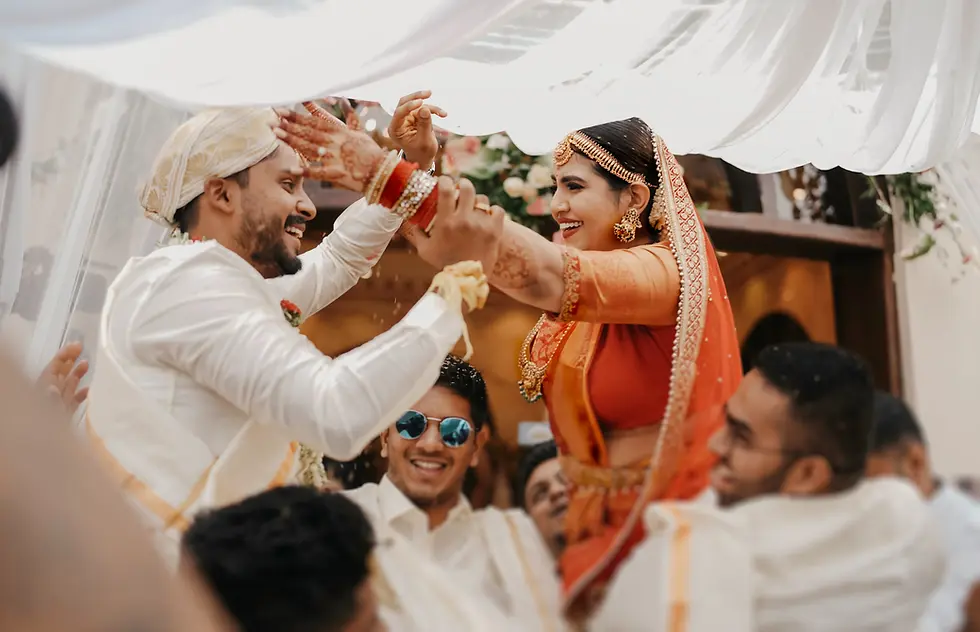
The Maalai Maatral - Garland Exchange (Tamil Brahmin)
FAST, PHYSICAL, AND JOYFUL, MULTIPLE FRAMES PER SECOND REQUIRED
Unique to Tamil Brahmin weddings — the couple exchanging garlands while families playfully lift each partner to prevent the other from completing the exchange. It is fast, dynamic, and full of laughing. You need to be shooting continuously before it begins and not stop until the garlands are exchanged and the laughter settles. This is one of the great candid wedding photography moments in any tradition.

The Tying of the Thali - The Central Moment
SILENCE FALLS. BE COMPOSED BEFORE IT DOES.
The mangalsutra moment. The groom ties the sacred thread around the bride's neck while the priest chants. The family falls momentarily silent. This is the central ritual of the Tamil Brahmin ceremony — and one of the most sacred moments in any South Indian wedding. Your composition, focus, and timing must all be correct before the first knot is tied. There is no second chance.

The Sacred Fire - Agni as Natural light Source
USE THE FIRE'S LIGHT. DON'T FIGHT WITH FLASH.
The sacred fire (agni) present at most South Indian ceremonies creates a natural light source that produces some of the most cinematic wedding photographs possible. Great South Indian wedding photographers learn to expose for the fire's warmth rather than overriding it with artificial flash. The couple's faces lit by fire, with the ceremony space visible in the background, is a frame that looks timeless rather than dated.

The Saptapadi - Seven Steps, Seven Photographs
MOVE QUIETLY BETWEEN EACH STEP. SEVEN OPPORTUNITIES
The couple circles the sacred fire seven times, exchanging vows with each step. Seven distinct moments — seven opportunities for a frame that captures both the ritual and the couple's expression simultaneously. Move quietly and purposefully between positions with each step. The saptapadi is long enough to build a narrative arc within a single ceremony.

The Dhare - Water Over Joined Hands (Kannada)
FRAME THE HANDS, NOT THE CEREMONY SPACE
Specific to Kannada wedding ceremonies, the dhare — the pouring of water over the joined hands of the couple — is one of the most visually distinctive and quietly beautiful ritual moments in South Indian wedding photography. The close-up frame works best: water, hands, the fabric of the silk, the flower petals. Wide angles lose the intimacy of this moment.

The Nalangu - Where Everyone Finally Realxes
BEST CANDID PHOTOGRAPHY OF THE ENTIRE DAY.
The nalangu games ritual — turmeric, rose water, playful competition between the couple and their siblings — is where the accumulated formality of the ceremony gives way to genuine joy. People who have been composed all morning are suddenly laughing without controlling it. This is consistently the most naturally candid photographic window of the entire South Indian wedding day. Be ready for it.
The Parents' Faces — Where Your Second Photographer Should Be
This is the most under-appreciated element of South Indian wedding photography, and the most consistently impactful. While your lead photographer covers the ceremony itself — the couple at the mandap, the ritual moments — your second photographer should almost always be positioned behind the family, watching the parents.
The father of the bride during the kanyaadanam. The mother of the groom when the thali is tied. The grandparent who has been composed for three hours and finally, when it's over and the couple touches their feet, stops holding it together. These are the photographs that will matter most to the family in twenty years — and they only happen when someone is watching.
This is one of the primary reasons we always bring two photographers to every South Indian wedding we cover in Bangalore and Hyderabad. The ceremony is too layered, too emotionally rich, and too fast-moving for one person to cover both the ritual and the family surrounding it.
"The moments worth keeping are almost never the ones that were planned. In a South Indian ceremony, they're the ones that happen in the space between rituals — when nobody is thinking about the camera."
LUXE FRANE STUDIOS - BENGALURU
Technical Considerations for South Indian Wedding Photography
Light in the Ceremony Space
Tamil Brahmin and Kannada ceremonies often take place in smaller, low-light mandap settings — particularly for families who prefer temple halls or traditionally decorated spaces over hotel ballrooms. Low-light candid wedding photography requires wide-aperture lenses and cameras with strong high-ISO performance. A flash-dependent approach at a South Indian ceremony is both technically inadequate and culturally disruptive. The best South Indian wedding photographers in Bangalore work entirely in available light wherever possible.
The Pace of the Ceremony
Tamil Brahmin weddings in particular move faster than most Western photographers expect — and faster than most Indian wedding photography generalists are prepared for. The Muhurtham window is fixed by the priest, and the key rituals happen in rapid succession once it begins. There is no pausing for the photographer. Preparation must be complete — positions confirmed, exposures tested, second photographer briefed — before the ceremony starts, not during it.
Physical Access to the Ceremony Space
Many South Indian ceremony spaces are compact, with family members seated very close to the ceremony itself. This requires a documentary approach rather than a studio one: working within the crowd, using shorter focal lengths, being comfortable at intimate distances without disturbing the family's participation in the ritual. The photographer who needs space and distance to work will not do well in a traditional Tamil Brahmin ceremony hall.

THE QUESTION THAT REVEALS EVERYTHING
When choosing a South Indian wedding photographer in Bangalore or Hyderabad, ask them to describe the ceremony sequence of your specific tradition from memory. A photographer who knows Tamil Brahmin weddings well will describe the kashi yatra, the oonjal, the maalai maatral, the thali tying, and the saptapadi without hesitation — and in the right order. One who doesn't know them will be vague. That vagueness will cost you photographs on your wedding morning that cannot be recovered.
What Makes Great South Indian Wedding Photography Different
The difference between a South Indian wedding album that documents the ceremony and one that tells the story of the day comes down to three things: ceremony knowledge, light management, and emotional intelligence.
Ceremony knowledge means anticipation rather than reaction. A photographer who knows that the maalai maatral is coming positions themselves before it begins. One who doesn't discovers it's happening when the garlands are already in the air.
Light management means using the ceremony's natural and ambient light — the sacred fire, the filtered daylight through the mandap, the warm tungsten of the hall — rather than imposing artificial flash on a space that has its own visual character. The best South Indian wedding photographs in Bangalore look like they belong to the ceremony setting, not like studio portraits placed inside one.
Emotional intelligence means knowing when to be a journalist — invisible and observant — and when to be a gentle presence that helps people relax into genuine expressions. South Indian ceremonies require both modes, sometimes within minutes of each other.
The community-specific knowledge that separates excellent South Indian wedding photography from average coverage is earned through experience, study, and genuine respect for the traditions being documented. It cannot be improvised on the day.

Comments